
Washing machine leaking water in Dubai? Find the real cause in minutes, know what you can check yourself, and when it’s time to call a technician.
Washing Machine Leaking Water in Dubai?
Water spreading across the laundry room floor has a way of making a small problem feel like an emergency. It always shows up at the worst possible moment, and it always looks worse than it actually is. Here’s the reassuring part, based on years of house calls across Dubai: a Washing Machine Leaking Water almost always comes from one of a handful of predictable spots, and most of them take five minutes to check safely, with no tools required.
This guide walks through every common cause, tells you honestly which ones you can check yourself and which ones need a technician, and covers what’s genuinely different about running a Washing Machine Leaking Water in Dubai — the water, the heat, and the fact that a huge share of us are renting in buildings where a leak isn’t only our own Washing Machine Leaking Water in Dubai?
Water spreading across the laundry room floor has a way of making a small problem feel like an emergency. It always shows up at the worst possible moment, and it always looks worse than it actually is. Here’s the reassuring part, based on years of house calls across Dubai: a washing machine leaking water almost always comes from one of a handful of predictable spots, and most of them take five minutes to check safely, with no tools required.
This guide walks through every common cause, tells you honestly which ones you can check yourself and which ones need a technician, and covers what’s genuinely different about running a washing machine in Dubai — the water, the heat, and the fact that a huge share of us are renting in buildings where a leak isn’t only our own problem to fix.
The Fast Read: Where Most Leaks Actually Come From.
In the vast majority of cases, a leaking washing machine comes down to one of four things: a worn or torn door seal, a loose or cracked drain hose, a blocked detergent drawer, or a failing water inlet valve. Before touching anything, switch off the power at the wall and shut the water tap feeding the machine. Then work through the checks below in order, starting with whichever one is closest to where you actually see the water.
| Where the leak is | Likely cause | DIY or call a technician |
|---|---|---|
| Around the door (front-load) | Worn door seal, trapped object, detergent build-up | Check it yourself; call a technician if the seal is torn |
| Underneath, front | Loose drain hose connection, cracked hose | Usually a DIY fix |
| Underneath, back | Water inlet valve or fill hose leak | Better left to a technician |
| From the detergent drawer | Blocked drawer, wrong detergent, low water pressure | Simple DIY clean |
| From the base, mid-cycle | Worn tub seal or bearing | Needs a technician |
| Only during spin | Overloading, unbalanced load, cracked drum | Rebalance the load first |
Why Washing Machine Leaking Water in the First Place.
A washing machine is a sealed system of hoses, valves, gaskets, and a pump, all working under real pressure every time it fills or spins. Any single weak point in that chain — a hose clamp, a rubber seal, a clogged filter — can let water find its way out. Age wears these parts down naturally. So do hard water and habitual overloading, both of which are common enough in Dubai homes that they’re worth their own section further down.
In most of the homes we visit, the leak has actually been building for weeks before anyone notices it. A slightly damp patch behind the Washing Machine Leaking Water gets wiped up and forgotten a few times before the seal finally gives way and it turns into an actual puddle.
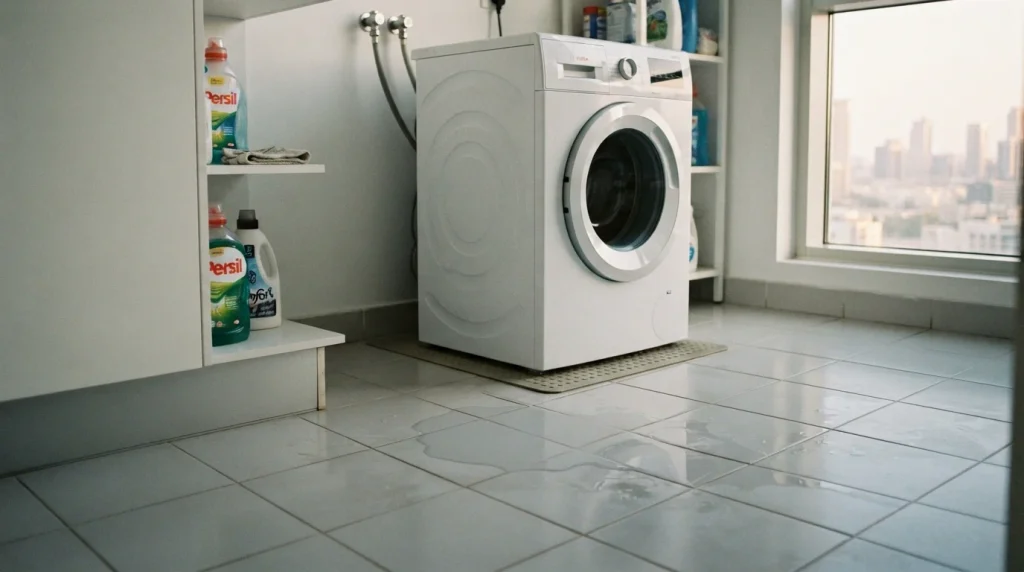
Front-Load vs. Top-Load: Different Machines, Different Weak Points.
Front-Load Washers.
Front-load machines leak most often from the door seal, and there’s a simple reason: the door sits below the waterline during the wash, so the gasket is doing real work holding water back rather than just keeping it from splashing. A cracked or twisted gasket, or something as small as a coin or a hair clip caught in the fold, is enough to break that seal.
Top-Load Washers.
Top-load machines rarely leak from the lid, since it sits above the water level. Instead, look lower down — the water inlet valve, the hose connections at the back, or a cracked outer tub, all of which sit closer to the pump and take the brunt of the pressure. If you own a top-loader and can’t place where water is coming from, our washing machine repair technicians in Dubai can usually diagnose it within a single visit.
Leak From the Bottom of the Machine.
A leak from underneath usually points to one of three things: the drain hose, a hose clamp, or the pump seal. Start by checking the drain hose where it connects to the machine and where it connects to the wall drain. A loose clamp is the single most common cause, and tightening it costs nothing and takes about two minutes.
Leak Around the Door.
Door leaks almost always trace back to a damaged or dirty seal, or a door that isn’t closing fully. Run your hand slowly around the inside of the gasket, feeling for any crack, split, or stiff patch. Check the fold at the bottom of the seal for anything trapped — hair clips, coins, and small buttons collect there more often than you’d expect. Finally, wipe away any built-up soap scum, since a film of residue is sometimes all it takes to stop the door closing flush against the seal.
Leak From the Drain Hose.
A cracked, kinked, or loose drain hose is one of the easiest leaks to fix yourself, and also one of the most common. Turn off the machine and unplug it at the wall. Pull the machine forward carefully, giving yourself room to see the hose along its full length. Check for cracks or splits, particularly where the hose bends. Reseat the hose fully at both ends and tighten the clamps.
Leak From the Detergent Drawer.
Water overflowing from the detergent drawer is almost always a blockage or the wrong type of detergent, not a mechanical fault. Pull the drawer out completely and rinse it under warm water to clear built-up residue. Clean the housing behind it too, since that’s where soap scum and limescale collect fastest. If this keeps happening, switch to a low-suds detergent made specifically for automatic machines — regular hand-wash powder foams too aggressively and backs up through the drawer.
Step-by-Step Safety Checks You Can Do Right Now.
Safety comes first here: switch off the power and shut the water supply before touching anything, and never open electrical parts while the machine is still plugged in.
- Unplug the machine and turn off the water tap behind it.
- Pull the machine out gently and look underneath for the source of the water.
- Check the door seal for cracks, splits, or anything trapped in the fold.
- Inspect the drain hose along its length and check both clamps.
- Open and rinse the detergent drawer and its housing.
- Check the inlet hose connection at the wall.
If the leak seems to be coming from inside the drum housing, or you genuinely can’t find the source after all of this, stop there and call a technician rather than opening anything further.
Common Mistakes That Make a Leak Worse.
- Running another cycle “just to see if it stops” — this usually makes things worse, not better.
- Ignoring a small drip because it doesn’t seem bad enough to deal with yet.
- Using too much detergent, which forces suds out through the drawer or door.
- Overloading the drum, which puts extra strain on both the door seal and the bearings.
- Trying to open the control panel or motor housing without switching off the power first.
Myths vs. Facts About Washing Machine Leaks.
| Myth | Fact |
|---|---|
| “A little leak isn’t urgent.” | Small leaks damage flooring and encourage mould well before they look serious. |
| “All leaks mean the machine is broken.” | Most leaks are one worn part, not a full mechanical failure. |
| “Front-load machines leak more than top-load.” | Both leak about equally often — just from different parts of the machine. |
| “Tightening the hose always fixes it.” | It only fixes loose-connection leaks, not seal or valve failures. |
Warning Signs You Shouldn’t Ignore.
- Water pooling near any electrical outlet.
- A burning smell alongside the leak.
- The leak getting worse with every single wash, rather than staying the same.
- Rust or discoloration appearing around the base of the machine.
- The machine tripping the circuit breaker whenever it leaks.
When to Stop the DIY and Call a Technician.
Call a technician if the leak is coming from inside the drum housing, if it’s paired with a burning smell or a tripped breaker Washing Machine Leaking Water, or if you’ve checked the seal and hose thoroughly and still can’t find the source. The same goes if the machine is more than seven or eight years old and this is the second leak it’s had this year — at that point, further DIY attempts usually just delay a repair that needs the right parts and tools anyway. If that’s where you’ve landed, our appliance repair team can take it from here.
A Pattern We See Often: The Two-Week Delay.
This isn’t any one customer in particular — it’s a pattern that shows up across a lot of Dubai apartments. Someone notices a small puddle behind the machine, wipes it up, and keeps washing. A week or two later, what looked like a minor drip turns out to have been a slowly splitting drain hose the whole time, and by then water has already worked its way into the floor trim. The hose itself is a quick Washing Machine Leaking Water, low-cost fix. The flooring repair that follows a two-week delay almost never is. Catching it in week one instead of week two is usually the difference between the two outcomes.
Washing Machine Leaks in Dubai: What Makes It Different Here.
Dubai’s tap water carries a noticeably higher mineral content than what many residents are used to, and that mineral content is exactly what forms limescale inside hoses, valves, and drum seals over time. As hard water evaporates it leaves calcium and magnesium deposits behind, and over time those deposits reduce appliance efficiency and shorten the working life of washing machines in particular — a pattern most major manufacturers, including Bosch’s own guidance on hard water and washing machines, point to directly. That’s one reason washing machines here tend to develop hose and valve leaks a little earlier than the manufacturer’s own timeline would suggest.
The heat plays its own part too. Rubber door seals and hoses dry out and lose flexibility faster when they’re stored in hot utility rooms or anywhere that gets direct sun through a balcony door, which is a fairly common laundry setup in Dubai apartments.
Apartments and villas experience the same leak very differently. In an apartment, water travelling through the floor can reach the unit below, which usually means a call to building maintenance — and sometimes a conversation with your landlord — before any repair work starts. In a villa, a leak is more likely to sit and damage the flooring or skirting in place, since there’s no unit underneath to worry about.
If you’re renting, it’s worth checking your tenancy contract before you do anything else. Many landlords in Dubai expect to be notified about appliance faults that risk water damage, especially in shared buildings where a leak could reach a neighbour’s ceiling. It’s a smaller conversation to have early than after the damage has spread. On a related note, DEWA itself advises residents to have internal connections and appliances checked periodically to catch hidden leaks before they cause damage — advice that applies just as well to a washing machine’s fill and drain lines as it does to the rest of a home’s plumbing.
We see this same pattern across most of the areas we cover — Dubai Marina Washing Machine Leaking Water, JLT, Business Bay, Al Barsha, Downtown, and JVC all report the same core causes. The heat and the water just get there a bit faster than they would elsewhere.
Preventing the Next Leak.
- Leave the door slightly open between Washing Machine Leaking Water so the seal can actually dry out rather than sitting damp.
- Wipe the door seal down weekly to stop residue building up in the fold.
- Check both ends of the hoses every few months, especially wherever they bend.
- Don’t overload the drum — clothes need room to move for the door seal and bearings to do their job properly.
- Use the correct detergent type and amount for your specific machine, not just whatever’s on sale.
- Book a yearly service check, particularly once the machine passes the five-year mark.
Closing Thoughts.
A leaking washing machine is annoying, but it’s rarely a mystery once you know where to look. Check the door seal, the drain hose, and the detergent drawer first, and you’ll have covered most cases before you even need to call anyone. If the leak keeps coming back Washing Machine Leaking Water, or you’ve gone through every check above and still can’t pin down where the water’s coming from, our technicians can be at your door the same day, anywhere across Dubai. Book a visit with Fixer Master Dubai and we’ll get it sorted properly, the first time.
.
Samsung washer showing an LE or LC leak code? Read our Samsung washing machine repair Dubai guide.